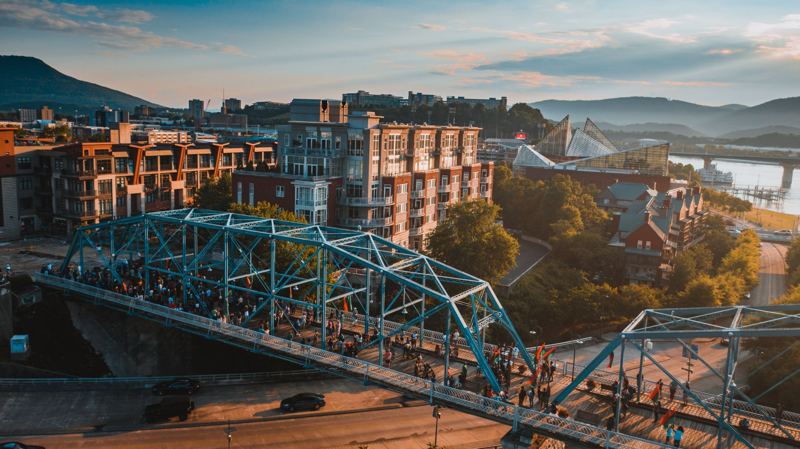
Walnut Street Bridge
The Bridge That Connects More Than Two Shores.
Built in 1891, saved by its neighbors, and walked by millions since — this is Chattanooga's front porch over the river.
At 2,376 feet — almost half a mile — the Walnut Street Bridge is one of the longest pedestrian bridges in the world. Its blue camelback trusses link Downtown's Bluff View Art District with Coolidge Park and the Northshore, and on any given evening you'll find commuters, joggers, dog walkers, and families stopping mid-span to watch the river.
The bridge's story is also the city's story. When it closed in 1978 and faced demolition, residents, preservationists, and civic leaders fought to save it. Its 1993 reopening as a walkway became a cornerstone of Chattanooga's riverfront revitalization and a model other cities have followed.
It carries harder history, too. In 1906, Ed Johnson was taken from jail and lynched on the bridge. Since 2021, the Ed Johnson Memorial at the bridge's downtown end has honored Johnson and the two Black attorneys who fought for him, Noah Parden and Styles Hutchins — a place for reflection on justice and on how a community reckons with its past.
History
A brief timeline
1891
The bridge is completed, linking downtown Chattanooga with the north shore of the Tennessee River. It is considered the first non-military highway bridge across the river.
1906
Ed Johnson, a Black man wrongly accused of a crime, is lynched on the bridge by a mob. The case that followed, United States v. Shipp, remains the only criminal trial in U.S. Supreme Court history.
1978
The bridge closes to traffic over safety concerns, and demolition is considered.
1990
After a community campaign to save it, the bridge is added to the National Register of Historic Places (February 23).
1993
Restored and reopened as a pedestrian and bicycle bridge — an early, influential example of bridge reuse that helped spark the riverfront's revival.
Walk the Bridge
Downtown → Northshore in one easy stroll
Start in the Bluff View Art District, cross the river, and end on Frazier Avenue. The orange line shows the bridge deck.
- 1
Start: Bluff View
Wander the Hunter Museum's sculpture plaza and the Bluff View Art District.
- 2
South access
Join the bridge where Walnut Street meets the bluff, near the Ed Johnson Memorial.
- 3
Mid-span
Pause for views upriver to the Market Street Bridge and downriver toward Lookout Mountain.
- 4
North access
Step down into Coolidge Park — the carousel is right there.
- 5
Finish: Frazier Avenue
Browse galleries and shops, grab ice cream, and stay for dinner.
- Directions to the bridge
Scenic photo spots
- Coolidge Park lawn
Frame the full span with the downtown skyline behind it.
- Hunter Museum plaza
Look down on the bridge from the bluff, especially at golden hour.
- Mid-span
Stand in the center of the deck for symmetrical truss shots and river views both ways.
- Renaissance Park
A lower, side-on view of the trusses from the Northshore riverbank.
Eat, shop & linger nearby
A few Northshore spots within a short walk of the bridge's north end.
For closures, events that restrict access, and official information, see the City of Chattanooga's Walnut Street Bridge page.
History sources: Advisory Council on Historic Preservation · Structurae / HAER · The Clio.